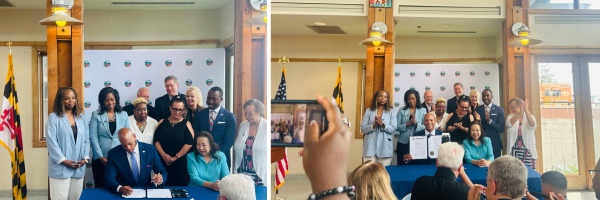
In a powerful and precent-setting moment, Governor Wes Moore has taken a groundbreaking step in the fight for environmental equity by signing Maryland’s first-ever Environmental Justice (EJ) Executive Order (EO). At a time when federal protections are being dismantled, Maryland is charting its own course—one that centers equity, accountability, and community partnership at the heart of state government operations.
Announced at a special event alongside key leaders and advocates, the Executive Order affirms that environmental justice is not just an ideal—it is a state-wide priority embedded in how Maryland governs, protects, and uplifts its people.
This EO is “a directive for action and a blueprint for equity,” said Governor Moore. He went on to state that this reflects Maryland’s unwavering commitment to environmental justice, regardless of what is happening in Washington, D.C., or elsewhere. Every single agency in Maryland will be part of this work, because it is core to what we do and who we are.
Governor Moore laid out three core pillars of the EO:
- Following the Data
The Maryland Department of the Environment (MDE) is home to our EJ screening tool and is launching an updated mapping resource tailored specifically for Maryland. This will be critical for us to work independently of federal sources, given the lack of support for, and erasure of, EJ data by the Trump Administration. Furthermore, Governor Moore explained that the new tool ensures that every agency is working from the same, state-specific information on environmental hazards and community risks.
- Prioritizing Partnerships with Communities
“We focus on people,” Moore declared. The EO directs agencies to prioritize deep, meaningful engagement with the communities most impacted by environmental injustice—from grassroots leaders to farmers and rural residents. This includes addressing barriers that have historically excluded farmers and others from full participation, such as access to financing and land. This will also drive economic growth across Maryland, from Western Maryland to the Eastern Shore.
- Creating Accountability Across Government
The order creates an Interagency Environmental Justice & Equity Council, chaired by MDE, with a mandate to submit regular progress reports to the Governor. Action without accountability is just rhetoric. Every agency will now be responsible for tracking and reporting progress so we can measure impact and stay on course.
Governor Moore underscored the urgency of this work by pointing to staggering disparities: Baltimore’s asthma rates are among the worst in the country, and Maryland is home to some of the most extreme heat islands in the U.S. These are not abstract issues—they affect the air our children breathe and the water our families drink. Speaking directly to young people, Moore reminded the audience that this work is about the future, stating an obligation to leave our children a better world.
In addition to Governor Moore, the event featured remarks and support from several key leaders in the environmental justice movement, including:
- Serena C. McIlwain, Secretary, Maryland Department of the Environment
- Delegate Jazz Lewis, sponsor of the CHERISH Act
- Vernice Miller-Travis, nationally recognized environmental justice advocate
- Camille Burke, Chair, Commission on Environmental Justice and Sustainable Communities
- Gabriela Lemus, Executive Director, Maryland Latinos Unidos, and board member of the League of Conservation Voters
Governor Moore’s Environmental Justice Executive Order marks a new chapter in Maryland’s environmental and equity journey. With community, data, and interagency accountability at its core, the EO positions Maryland as a national leader in advancing real, lasting change. The work ahead will be ongoing, but the foundation has been set, and the path forward is clear.
We certainly commend Governor Moore on his intentionality and commitment to showing up for our frontline communities. While the White House is cutting jobs and dismantling environmental justice programs and other support systems that working families rely on, Maryland can prove that there’s a better way. We will prove that, and we are looking forward to working with the Governor on seeing this environmental justice work through.

Do you like this page?